Learning something new is rarely just about technique.
Whether you’re picking up a guitar or a rattan stick, the real challenges often live inside: self-doubt, frustration, or the fear of not being “good enough.”
Two of my students, A. and V., started their journeys in both guitar and Balintawak Arnis with very different backgrounds and personalities. Yet both discovered that the inner battles were just as important as the physical or technical ones. Their stories show how growth comes not just from repetition, but from learning how to face yourself.
A.: From overthinking to flow
A. came to guitar with baggage. Years earlier, she had studied classical guitar for four years, only to give it up out of frustration and disappointment. Picking it up again meant facing the fear of repeating that “failure.”
“I often grew frustrated when I could not master a task within the first few attempts, and at times, I would stop practising altogether, discouraged by my inability to succeed immediately in something new.”
Balintawak Arnis was different — she walked into it almost by accident at a training camp. At first, she blamed her struggles on external factors: stronger opponents, unpredictability, physical differences. But soon she discovered the real lesson: technique, rhythm, and agility mattered more than brute force.
Her turning points were clear:
- In Balintawak, when her body began reacting instinctively to strikes.
- In guitar, when she could finally play in tempo with backing tracks.
Both gave her a flash of confidence. And even though doubt crept back at times, she slowly learned to stop overthinking and let her training carry her forward.
“Learning to stop overthinking has been the most important change. Acting without excessive deliberation often revealed abilities I thought I lacked.”
V.: From clumsy fingers to confidence
V.’s story started closer to home: his father played guitar and encouraged him to try both music and martial arts. For him, the challenges weren’t psychological at first, but physical.
“In my first year of playing guitar, the biggest difficulty was that my fingers weren’t used to pressing on the strings… there were moments when I felt like I had spaghetti instead of fingers and they wouldn’t stay in place.”
With Balintawak, it wasn’t fingers — it was feet. Learning to coordinate movement under pressure felt awkward and discouraging. But persistence paid off.
His breakthroughs came as small but powerful realizations:
- Discovering random drilling in Balintawak — realising he could defend himself in unexpected exchanges.
- Unlocking the CAGED system on guitar — seeing how the fretboard connected in ways he had never imagined.
“Suddenly, I started trusting what I could do with a stick or a guitar in my hand.”
V.’s biggest lesson was simple but profound: break things down. If an exercise or lick felt impossible, he split it into smaller parts until it became doable — a principle he now applies beyond music and martial arts.
Two journeys, shared lessons
Though A. and V. faced different obstacles, their stories mirror each other in key ways:
- A.’s mantra: stop overthinking, trust the process.
- V.’s mantra: break it down, step by step.
Both discovered that confidence doesn’t arrive at the beginning — it’s built through small wins, persistence, and the courage to keep going when it feels clumsy or frustrating.
Advice for anyone starting out
A. says:
“My advice would be to simply begin. Try the activity, practise consistently, reflect on your progress, and then decide whether you wish to continue.”
V. adds:
“Although it seems complicated, things don’t stay as hard as they look in the beginning. Don’t give up and practice as much as you can at home.”
Closing Reflections
Looking back, A. is proud that she learned not just to play, but to listen — really listen — both to music and to her opponent. V. is proud that he stuck with it and he didn’t quit when things felt impossible.
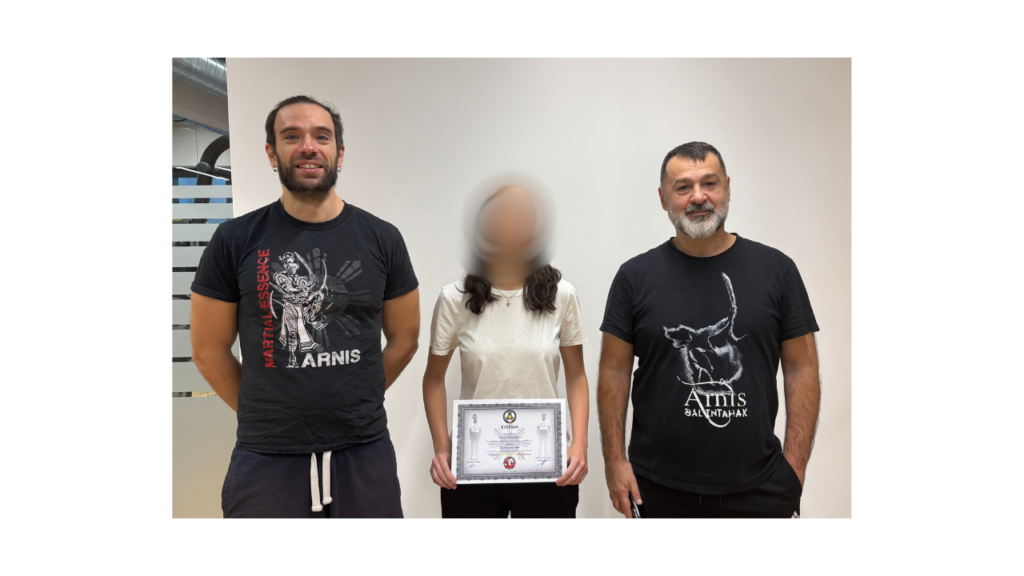
Both now walk forward with more confidence, patience and resilience — on the fretboard, in training, and in life and as living proof, A. just received her first degree certificate as a balintawak practitioner, from the Romanian Federation of Filipino Martial Arts. I am super proud to present you 3 generations of practitioners in this photo and thus, extend my thanks to my master in arms, Dragoș Chiric – the man from whom I still learn to this day and that you will meet next week, in an extensive interview.
Thus, their journeys remind us: technique matters, but in the end the biggest victories are the ones you win against yourself.
Cosmin