Lessons from Music, Martial Arts, and Mind
If you’ve ever picked up a guitar for the first time, you know the sting. Those thin steel strings press into soft fingertips, leaving little grooves and a dull ache that lingers long after practice. Most beginners think, “Something’s wrong — this hurts!” But ask any seasoned guitarist, and they’ll smile: “That’s how you know you’re on the right path.”
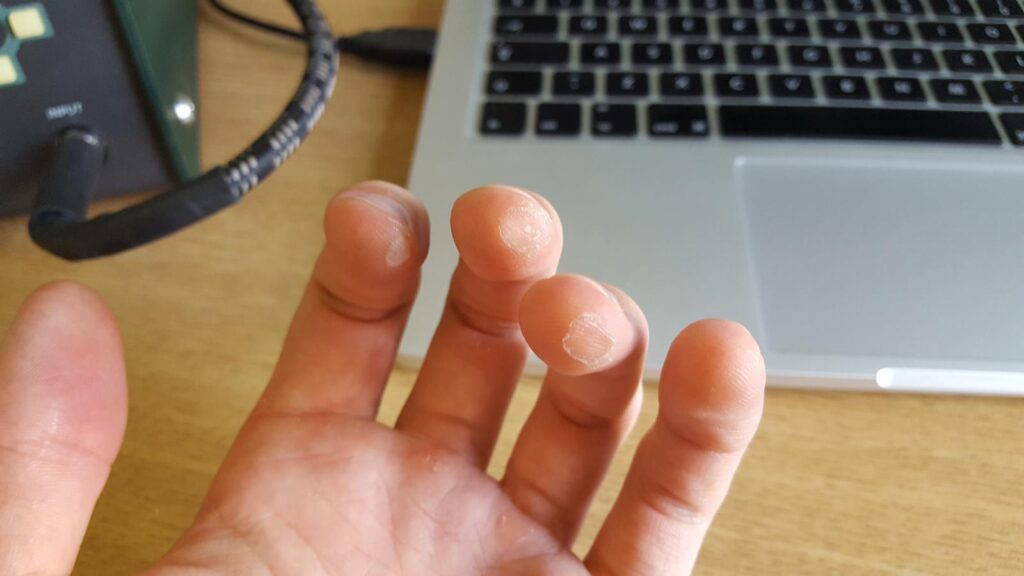
The Guitarist’s Callus
The pain doesn’t last forever. In a few weeks, the skin adapts. A protective callus forms. The sting dulls, the strings feel softer, and suddenly your fingers are free to express music without hesitation. What once felt like punishment becomes proof of progress.
The Martial Parallel
The dojo teaches the same lesson. In kenjutsu or arnis, wrists ache from swinging the sword, hands redden from impact drills, and forearms, arms, abdomen or ribs the – memory of every strike. At first, the body resists. But little by little, it adapts. Bones toughen, tendons strengthen, reflexes sharpen. Just like on the guitar, the pain is not an obstacle — it’s the curriculum.

Psychology of Pain
In psychology, we call this reframing. Pain, whether physical or emotional, is not automatically the enemy. It can be a signal of growth, adaptation, or the stretching of limits. The key is learning to differentiate between harm (which we should avoid) and the natural discomfort that comes with transformation.
The Takeaway
Discomfort is not a mistake. It’s the body’s proof that you’re growing. A guitarist’s callus, a swordsman’s wrist, a mind stretched by new challenges — all are signs that the path is unfolding as it should.
So the next time your fingertips burn, your arms ache, or your heart feels the strain of change, remember: the callus and the katana both whisper the same truth — pain is a teacher, not an enemy.
Practical Ways to Work With Discomfort
- Start small, but stay consistent. A few minutes of daily practice beats an occasional marathon that only leaves you wrecked.
- Listen for the difference between pain and injury. Sharp, stabbing, or worsening pain is a warning; dull, fading discomfort usually means growth.
- Reframe the signal. Instead of saying “this hurts,” try “this is my body adapting.” Language changes perception.
- Rest and recover wisely. Growth happens in cycles — stress, rest, adaptation. Respect all three stages.
- Celebrate the milestones. That first clean chord, that strike that finally lands, that insight after a hard conversation — they’re proof the discomfort was worth it.
At its heart, the way of the guitarist — like the way of the warrior — is not about avoiding struggle but transforming it. Every note pressed through a callus, every strike delivered through sore muscles, every lesson learned through discomfort carries a hidden gift: resilience, clarity, and a deeper connection to your art and your self. Embrace the sting, the ache, the stretch. They are not barriers on the path — they are the path.
🌒 Between the string, the blade and the mind, lies the lesson of becoming.
Cosmin